The History That Never Happened
We are accustomed to reading history as a sequence of events that actually took place, treating their outcomes as though they were the inevitable conclusions of processes that had begun centuries earlier. Yet we often overlook a fundamental truth: every historical event that occurred was surrounded by alternative possibilities that never materialized, and the history we know represents only one path among many that might have been taken.
What if the Persians had not been defeated at the Battle of Marathon in 490 BCE? What if Julius Caesar had not been assassinated in 44 BCE? What if the Muslims had not emerged victorious at the Battle of Yarmouk in 636 CE? Would the political and cultural map of the world look as it does today?
These questions are far from mere intellectual indulgence. Rather, they open the door to a deeper understanding of the nature of history and the limits of historical determinism. When examining a particular event, historians sometimes tend to interpret it in light of its eventual consequences, making the past appear as though it had been moving inevitably toward the present. Yet those who lived through such moments had no knowledge of the future, nor could they have realized that their decisions would later become historical turning points.
Throughout history, leaders, kings, and societies have faced multiple choices, with their decisions shaped by interests, fears, ambitions, and circumstances. The illness of a military commander, a sudden change in the weather, a delayed message, or an error in judgment may have been enough to tip the balance in favor of one historical course over another.
This is where the significance of what is known as counterfactual history comes into play. This approach is based on asking a fundamental question: What if events had unfolded differently? Its purpose is not to invent an imaginary past, but rather to test the strength of historical explanations and distinguish decisive causes from secondary factors.
Nevertheless, this approach has its limitations. Possibilities must never be presented as established facts, nor should hypothetical scenarios be constructed independently of the circumstances and evidence of their historical context. Serious counterfactual history does not ask merely what can be imagined, but what could realistically have happened in light of the available historical evidence.
Perhaps the deeper paradox is that the history that never happened can sometimes help us understand the history that did happen more effectively than conventional historical narratives. It reveals the fragility of certain outcomes that we now regard as firmly established and reminds us that civilizations, empires, and states could not foresee their own destinies.
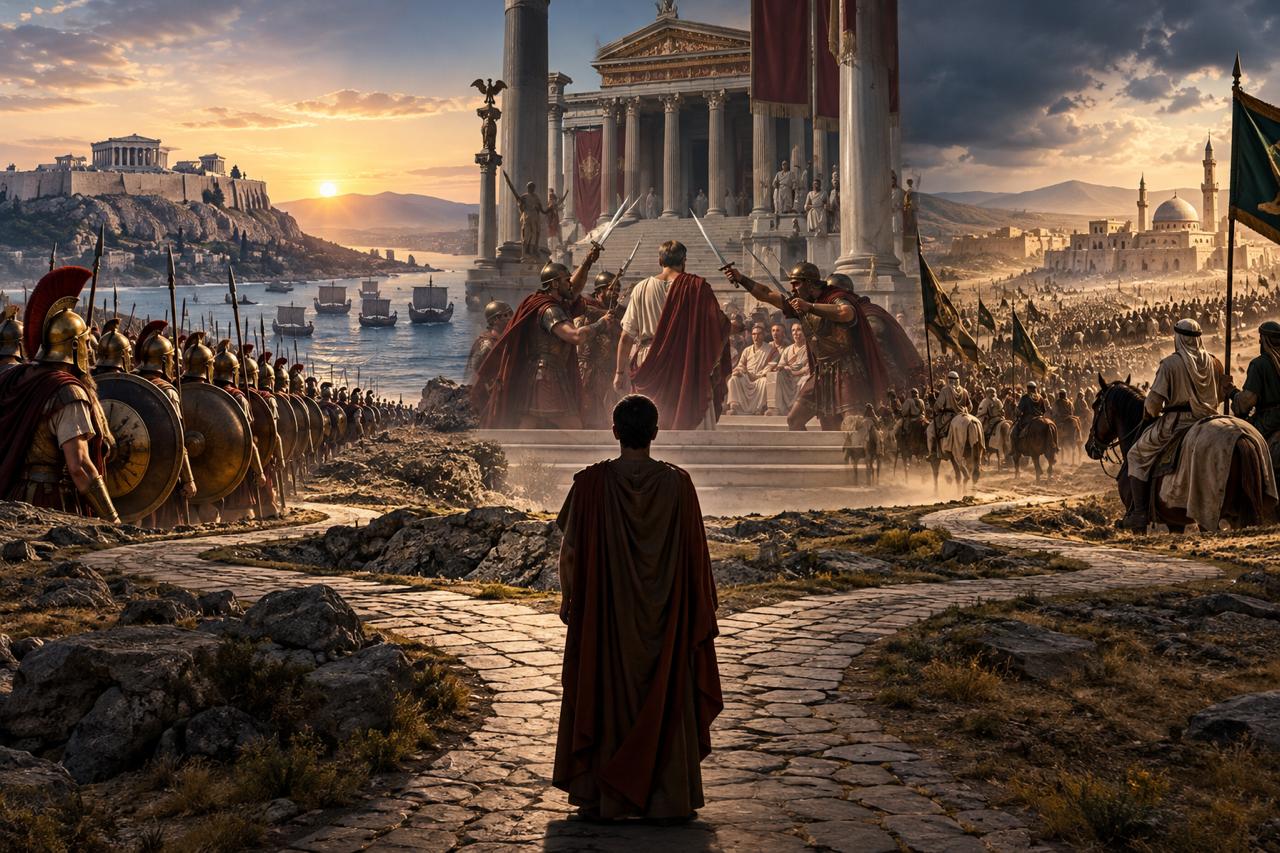
The greatest mistake we can make when interpreting the past is to view it through the lens of the present, attributing to historical events a certainty that those who shaped them never possessed. History was never a predetermined road. Rather, it was a continuous crossroads, where human beings chose certain paths while circumstances closed off others.
Perhaps the true greatness of history lies not only in understanding what happened, but also in recognizing the vast possibilities of what might have happened—and never did.