Security of the Two Holy Mosques: An Enduring Legacy Strengthened under Saudi Kings
The security and peace of mind visitors enjoy at the Two Holy Mosques reflect decades of sustained efforts by the Kingdom of Saudi Arabia, which has placed the security of the Two Holy Mosques and the service of their visitors at the heart of its responsibilities. Over the years, the Kingdom has continued to develop an integrated security system that has expanded alongside the holy sites and evolved to meet changing challenges.
This report follows a video published by the Ministry of Interior on its official X account, presenting historical footage for the first time that documents part of this journey. The video highlights the efforts of the Kingdom’s leadership, from the era of King Abdulaziz bin Abdulrahman Al Saud to that of Custodian of the Two Holy Mosques King Salman bin Abdulaziz Al Saud, to establish and develop the security system of the Two Holy Mosques.
When King Abdulaziz bin Abdulrahman Al Saud entered Makkah, a new chapter began in the history of caring for the Two Holy Mosques. Security was not treated as separate from the development of the holy sites, but as an integral part of their care and a necessity along every route leading to the Grand Mosque, the Prophet’s Mosque, and the holy sites.
During the reign of King Abdulaziz, the state’s responsibility extended far beyond securing a single season. It involved establishing security in two cities that receive Muslims from around the world. This marked the beginning of the modern security system, with the establishment of police services and the development of institutions dedicated to training security personnel. One notable milestone was the establishment of the Police School in 1354 AH by order of King Abdulaziz, laying a key foundation for security training in the Kingdom.
During the reign of King Saud bin Abdulaziz Al Saud, the development of the Two Holy Mosques expanded further. The first Saudi expansion of the Grand Mosque, initiated under the directives of King Abdulaziz, began during King Saud’s reign and was completed during the reign of King Faisal.
As the space expanded, so did the responsibility. More roads, larger courtyards, and growing numbers of pilgrims meant that managing their movement could no longer be regarded as a limited field operation. It developed into the science of crowd management, bringing together roads, entrances and exits, transportation, services, and security.
During the reign of King Faisal, the Kingdom continued to strengthen services and security in Makkah and the holy sites alongside the expansion of infrastructure and road, water, and electricity networks. A new approach to security began to take shape: rather than waiting for congestion to occur before responding, efforts focused on preventing congestion from becoming a risk.
During the reign of King Khalid, the Kingdom entered a new phase of infrastructure expansion, which was reflected in the Hajj and Two Holy Mosques sector.
The opening of King Abdulaziz International Airport in Jeddah in 1401 AH marked an important milestone in receiving pilgrims, coinciding with the expansion of road networks and advances in communications and organizational capabilities.
The reign of King Fahd witnessed one of the most significant periods of transformation in the history of the Two Holy Mosques. The Second Saudi Expansion expanded the Grand Mosque and included extensive projects for courtyards, facilities, and services. Movement, safety, and infrastructure systems at the holy sites also underwent major development.
During this period, engineering and security solutions emerged in response to the scale of the challenge, ranging from fire-resistant tents to improved roads and facilities and projects designed to facilitate the smooth movement of pilgrims.
During the reign of King Abdullah, the Two Holy Mosques entered a new phase of major projects with the launch of the third Saudi expansion of the Grand Mosque, accompanied by extensive development of courtyards, tunnels, facilities, and services to facilitate the smooth entry and exit of worshippers. The expansion of the Mataf, the Jamarat Bridge, and the Al Mashaaer Al Muqaddassah Metro served different functions but shared one objective: enabling millions to move with the greatest possible ease and tranquility and transforming an immense logistical challenge into a smoother and safer journey. The very design of the space became a contributor to security and peace of mind.
The Kingdom, under the leadership of Custodian of the Two Holy Mosques King Salman bin Abdulaziz Al Saud has continued expansion projects and its care for the Two Holy Mosques and the holy sites, alongside a broader transformation in management and services in line with the objectives of Saudi Vision 2030. With the follow-up of His Royal Highness Prince Mohammed bin Salman bin Abdulaziz Al Saud, Crown Prince and Prime Minister, the development of Makkah and Madinah has entered a more comprehensive phase integrating infrastructure, digital transformation, crowd management, and improvements to the pilgrim experience. Security today extends beyond monitoring the field; it encompasses systems that collect data, analyze movement, and support decision-making.
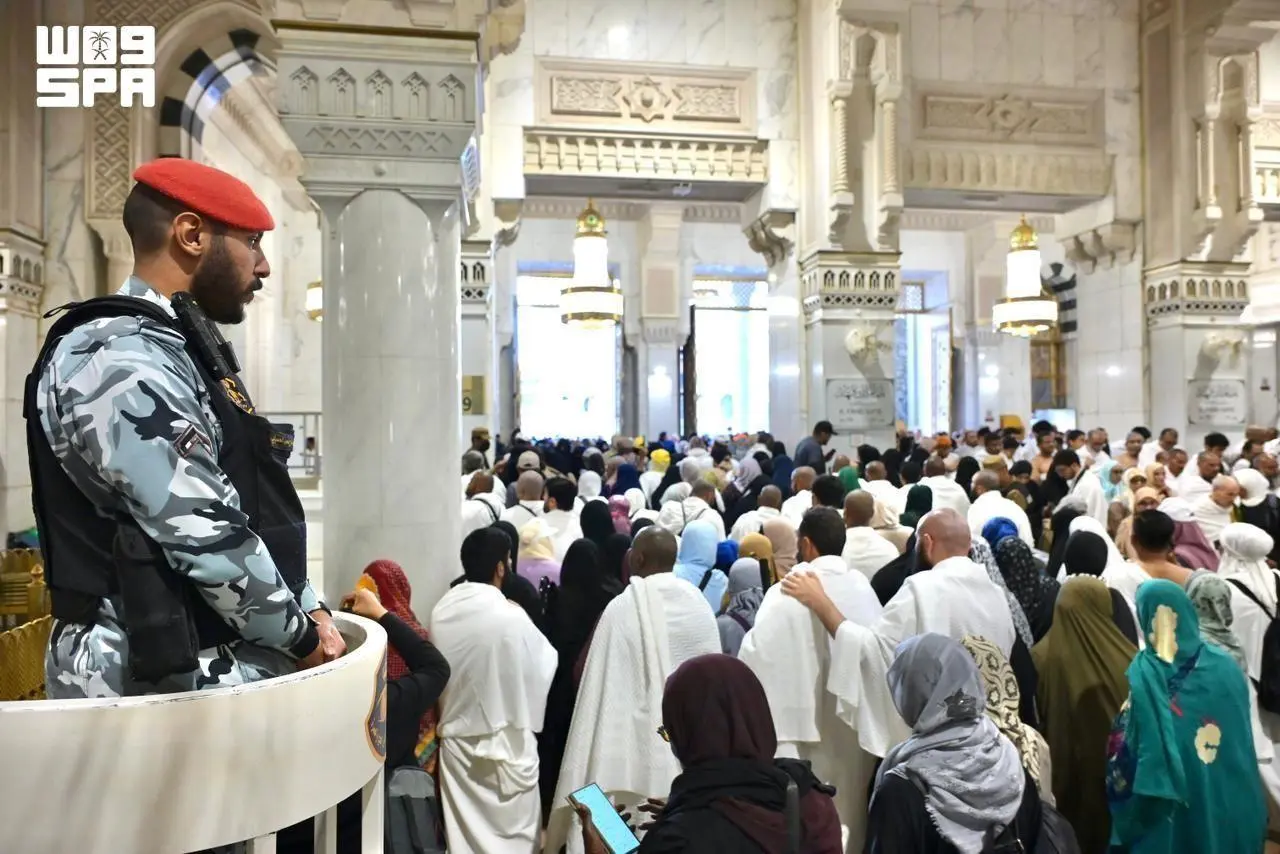
Throughout this journey, the security of the Two Holy Mosques has a broad national system bringing together security agencies, health services, transportation, municipalities, operational services, entities concerned with the Two Holy Mosques, and other sectors working in coordination.
Today, the Kingdom's security system looks beyond the present and prepares for a future in which visitor numbers continue to grow, needs evolve, and technology advances rapidly. Here, in Islam’s holiest places, security takes on a broader meaning. It is not merely about protecting buildings, monitoring roads, or managing crowds; it is about the pilgrim who has traveled from afar in response to the call of faith, the Umrah performer seeking tranquility, and the visitor wishing to worship in a safe and peaceful environment.
Today, accumulated experience and modern technology work side by side, forming an enduring legacy that does not remain rooted in the past but develops in every era into a new capacity to safeguard the present and shape the future.